Cinuos-chel and its Sgraffitos
An incredible hamlet in-between the Upper and Lower Engadin.
Costanza
5/19/20252 min read
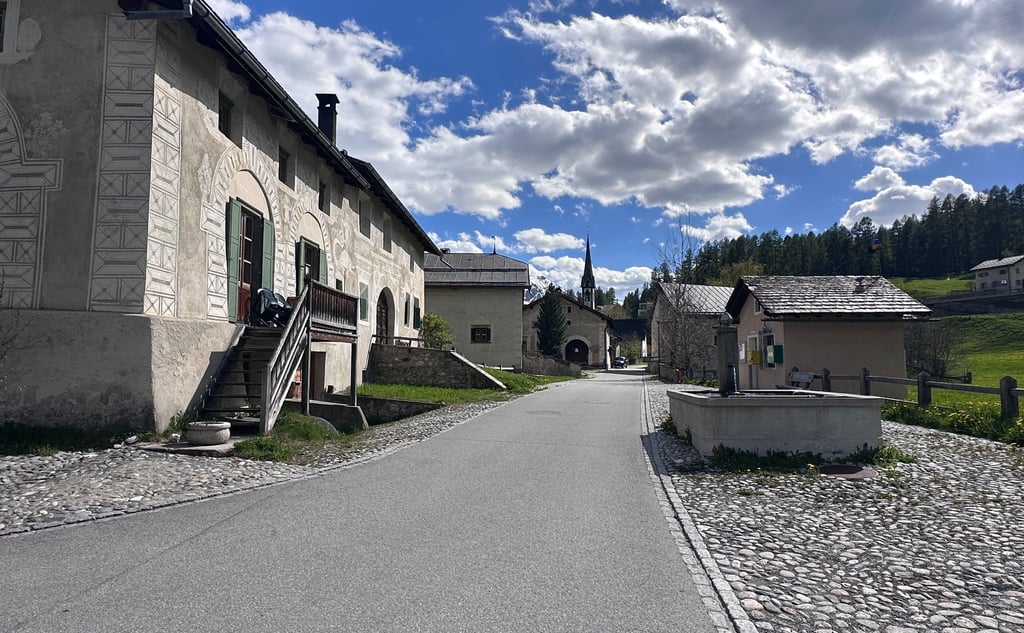

Cinuos-chel is a small village located near the point where the Upper and Lower Engadin meet. It lies on a meadow plateau above a rocky gorge. Although it has often been overlooked and mainly linked to the history of nearby S-chanf, its cultural and historical importance has gained more recognition in recent times. In fact, Cinuos-chel has preserved its traditional village layout remarkably well and has even been described as a place with houses of rare beauty.
The exact origins of the village are unknown. The first clear mention of the village comes from around 1577, when the historian Ulrich Campell referred to Cinuos-chel and nearby Susauna as small villages.
Cinuos-chel also showed a strong desire for independence. Together with Susauna, it adopted the Reformation earlier than the main parish of S-chanf. This was followed by a decision in 1612 to build its own church. In 1658, the village was granted permission by the synod to have its own preacher.
From an architectural point of view, Cinuos-chel is notable for its many examples of the “Engadiner Haus,” a traditional house type that was fully developed by the 16th century. A special feature of Cinuos-chel is the presence of sgraffito decorations on about half of its buildings.
This large number of Sgraffitos suggests that this form of decoration used to be much more common in the region. The fact that even houses belonging to less wealthy farmers have sgraffito indicates that it was not limited to rich families. While most examples of this technique have disappeared in other villages due to renovations, demolition, overpainting, or neglect, in Cinuos-chel they have been preserved to an exceptional degree.
The Sgraffitos in Cinuos-chel date from the mid-16th century to the 20th century. This makes it possible to trace their stylistic evolution from Gothic to Renaissance, Baroque, and Heimatstil (a style inspired by local traditions). Here below are mentioned two interesting examples among the several one present.
House No. 258: According to the inscription on the facade, this house dates from 1594. It reflects the decorative style when sgraffito became popular in the Engadin. The design combines Late Gothic elements with Renaissance features. These include imitations of architectural stonework such as rusticated blocks on the corners and around doors, as well as decorative window frames. The continuous friezes freely cover the façade. Some figures depict dolphin figures and delicate leaf patterns inspired by Northern Italy.
House No. 262/263
This house has one of the richest sgraffito decorations of the Upper Engadin. Its facade is framed with pilasters made of diamond-patterned rusticated blocks. It also has a richly decorated portal and window frames. In addition, the decoration includes plant and human-like figures. Leaf patterns surround the windows, and vases with large flower bouquets sit on imitation sills. Dragons and sirens, drawn from Italian Renaissance motifs, appear across the facade and may have been symbols to protect against misfortune. A sun motif with the letters IHS and a cross, a clear Catholic symbol, is found on the south gable of the house. An inscription above the Sulèr door reads “ANDREA ANNO 1659 CAPPON,” giving the date of the decoration. The illustrations only decorate one half of the double house, showing the separation between the two partes of the building.
Related Stories
Address
ENGADINWALKS.COM - GUIDED WALKS
Chesa Müstaila - Zuoz
Contacts
COSTANZA SAN MAURO
info@engadinwalks.com