PODCAST - Frescoes in the Alps: Unveiling the Artistic Treasures of Fex-Crasta Chapel
In this podcast, we dive into the fascinating history of the chapel, its artistic secrets, and the deep cultural ties it holds with the Engadine Valley — a place where history, faith, and art quietly meet.
Costanza
4/27/20254 min read
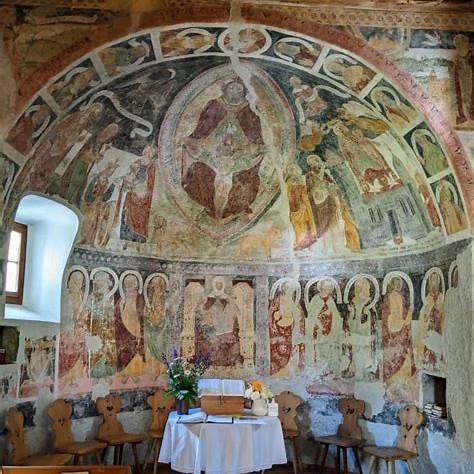
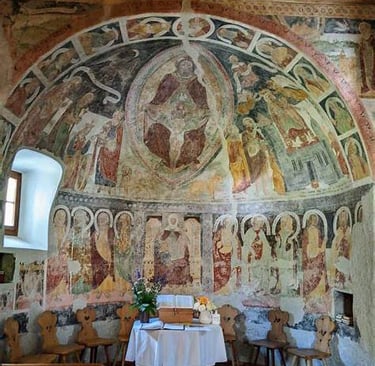
The Reformed Church of Fex-Crasta was built in the 15th century. It sits in the hamlet of Fex-Crasta, part of the Sils im Engadin municipality in the Swiss canton of Graubünden. Over the centuries, this small chapel has undergone several restorations, the most recent of which took place from 2005 to 2008. Despite its modest size, the church offers a fascinating contrast when compared with other religious buildings of its time. Its architecture blends the sturdy features of late Romanesque structures with the practical, humble style seen in Alpine churches of the 15th century.
Val Fex is a southern offshoot of the Upper Engadin and is widely known for its untouched alpine beauty and slow pace of life. Located at altitudes between 1,800 and 2,000 meters, the valley stretches out from Sils Maria and is bordered by peaks like Piz Corvatsch and Piz Tremoggia. Meadows, larch forests, and the Fex Glacier give the area a serene atmosphere that perfectly complements the quiet dignity of the church.
One unique feature of Val Fex is its car-free policy. Only residents may drive in the valley. Visitors walk or travel by traditional horse-drawn carriages, which leave from Sils Maria and make the journey feel like a step back in time. This peaceful, intentional approach enhances the spiritual experience of visiting the Church of Santa Margareta—as the chapel is also known.
Nearby, the village of Crasta stands as one of the small hamlets located in the valley.
The church is small and rectangular, with a semicircular apse at the back and a modest bell tower on its left side. It reflects a late Romanesque style but deviates from it with relatively large rectangular windows that date back to the 15th century—a rare feature in Alpine churches of that time. The building is whitewashed, simple, and functional. Inside, the wooden roof and single nave underscore its humble purpose.
Compared to typical Romanesque churches—which often have massive walls, round arches, and large towers—Fex-Crasta’s design is far more reserved. It also differs from the more elaborate 15th-century Alpine churches, which leaned toward Gothic elements like pointed arches and richly decorated altars. Instead, this church’s simplicity reflects the Reformation’s push toward austerity and clarity in religious settings.
Still, one of the most remarkable aspects of this chapel is that it preserved its frescoes—unlike many Protestant churches that removed or painted over religious images during the Reformation. This makes the Church of Fex-Crasta a rare case: a Protestant church that still holds on to its medieval Catholic artwork.
The frescoes inside the church date back to 1511. They cover the entire apse and are believed to be by an Italian master from Lombardy. His style was popular but traditional, closer to medieval art than the Renaissance look taking hold elsewhere. The frescoes were likely completed in just 11 days, using fast brushwork and finishing touches applied on dry plaster. While this quick method may have led to some fading, it also gives the paintings a raw, expressive quality.
At the center is a depiction of the Holy Trinity—God the Father, Christ on the Cross, and the Holy Spirit as a dove—enclosed in a mandorla, or almond-shaped halo. Flanking this are symbols of the four Evangelists: an angel for Matthew, an eagle for John, a lion for Mark, and a bull for Luke.
To one side, beneath John’s eagle, are the Virgin Mary and three consecrated virgins: St. Margaret with her dragon, St. Barbara with a chalice, and St. Catherine with a wheel and crown. St. Anne Medza appears among the apostles, emphasizing maternal grace and divine lineage. Other scenes include the Annunciation, the Holy House of Loreto, and Christ as the Man of Sorrows.
One notable detail is an inscription naming Antonio Dean as the donor. He also vowed to light the chapel at night for ten years—a deeply personal act of faith. Above his inscription is a fresco of the Holy House of Loreto, a reference to a legend about the Virgin Mary’s home being miraculously transported from Nazareth to Italy.
These images reflect the beliefs and spiritual life of the local community. The decision to cover them with whitewash during the Reformation protected them for centuries, and their rediscovery in the 20th century offered a window into the religious life of a mountain village 500 years ago.
The church still retains its original 15th-century rectangular windows. In 1939, Swiss artist Ernst Randerpacker added stained glass—abstract in style, using soft colours and textured glass rather than depicting stories. These windows offer a more modern take on sacred art, focused on mood and light rather than narration.
A small cemetery lies beside the church. It holds the ashes of Claudio Abbado, one of the 20th century’s most celebrated conductors. His grave is marked by a simple stone slab, fitting the understated elegance of the church and valley alike.
Preservation of the church’s frescoes has benefited from international support, including a grant from the Stavros S. Niarchos Foundation in 2002. The University of Applied Sciences and Arts of Southern Switzerland (SUPSI) has played a key role in studying and conserving the wall paintings. They use non-invasive methods like infrared photography, X-ray fluorescence, and spectroscopy to analyse the artwork without damaging it.
This research ties into a broader effort to study early medieval art across the Raetia Curiensis region, which includes parts of Switzerland, Northern Italy, and Austria.
The Reformed Church of Fex-Crasta stands as a quiet but powerful symbol of religious change, artistic resilience, and alpine culture. Its blend of Romanesque modesty and Gothic detail, its preserved frescoes in a Reformed setting, and its tranquil natural surroundings make it a unique spiritual site. Combined with the car-free landscape of Val Fex and the traditional horse-drawn carriage tours, the church offers visitors a rare chance to step back in time—physically, spiritually, and artistically.
Related Stories
Address
ENGADINWALKS.COM - GUIDED WALKS
Chesa Müstaila - Zuoz
Contacts
COSTANZA SAN MAURO
info@engadinwalks.com