Rhatische Bahn
A masterpiece on rails: the Rhaetian Railway
Costanza
5/13/20252 min read
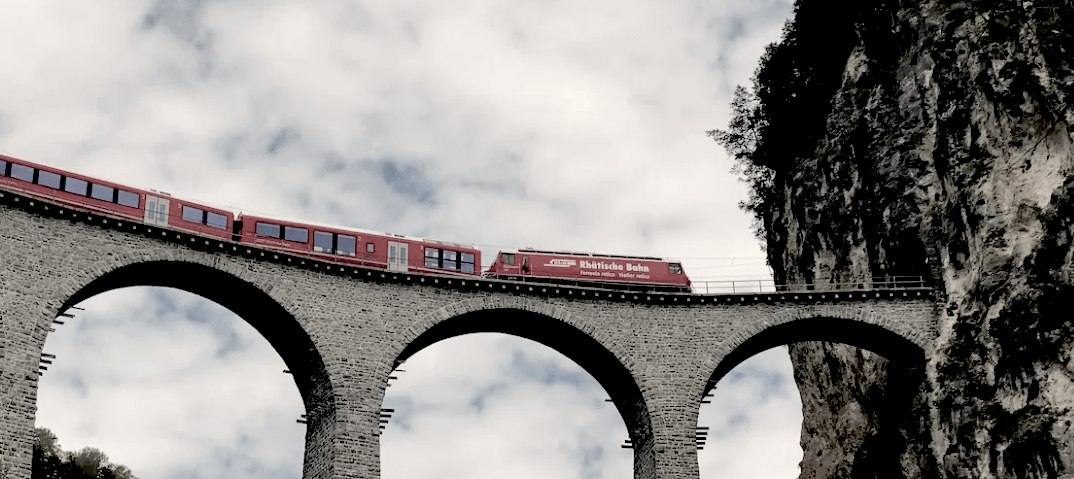
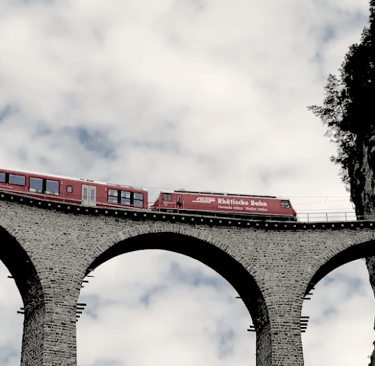
A red thread runs through the Alps, connecting valleys, mountains, and borders for almost 5,000 kilometers: this is the Rhaetian Railway, an extraordinary example of human ingenuity. Among all its lines, the most fascinating and iconic are undoubtedly the Albula and Bernina routes. These are two spectacular sections that offer a thrilling journey for both the eyes and the mind, surrounded by Alpine landscapes of rare beauty.
Thanks to their exceptional landscape and engineering value, these routes have been recognised as a UNESCO World Heritage Site.
Until the mid-19th century, Upper Engadin was difficult to reach. The main connections passed through ancient trade routes, such as the Splügen Pass and the Via del Settimo. Only with the arrival of the railway in Davos in 1890 and in Zermatt in 1891 did Engadin start considering new railway connections.
The result was the creation of the Albula line — a route designed not only for efficiency, but also to blend perfectly into the landscape. Built between 1898 and 1904, it stretches for 67 kilometers, from Thusis to St. Moritz, and includes 144 bridges and viaducts and 42 tunnels and galleries.
Along the way, there are several interesting sights:
St. Peter’s Church in Mistail, near Tiefencastel, is an 8th-century Carolingian-style church with three apses. It recalls the architecture of the Müstair convent. It was once part of a monastery — the name Mistail comes from this. The train passes in a wide curve around the church, which stands on a small hill.
The famous Landwasser Viaduct, 142 meters long and 65 meters high, built in natural stone. It is one of the most photographed sections of the line, also thanks to the spectacular moment when the train enters a tunnel directly at the end of the bridge.
The Albula Tunnel, built between 1899 and 1903 using very advanced techniques for that time. Just after it, the Spinas station still has its original wooden building.
Equally fascinating is the Bernina section, opened in 1910. This 61 kilometers route stands out for its high-altitude path, which includes 52 bridges and viaducts and 13 tunnels and galleries.
The line was also built for practical reasons: its construction was promoted and financed by private investors, who wanted to support the transport of materials for the Brusio hydroelectric power plant. Its tight curves and steep gradients were not only scenic choices, but engineering solutions to keep costs down. A clear example is the Brusio spiral viaduct, where the train makes a unique upward spiral, allowing passengers to admire this exceptional structure up close.
The Albula and Bernina lines are not just railway tracks: they connect regions and languages, cross borders naturally, link valleys, and tell an ancient story of exchanges, travel, and relationships.
Related Stories
Address
ENGADINWALKS.COM - GUIDED WALKS
Chesa Müstaila - Zuoz
Contacts
COSTANZA SAN MAURO
info@engadinwalks.com