The Romansh language and Gian Travers
The importance of Gian Travers in shaping the written tradition of Romansh
Costanza
8/10/20252 min read
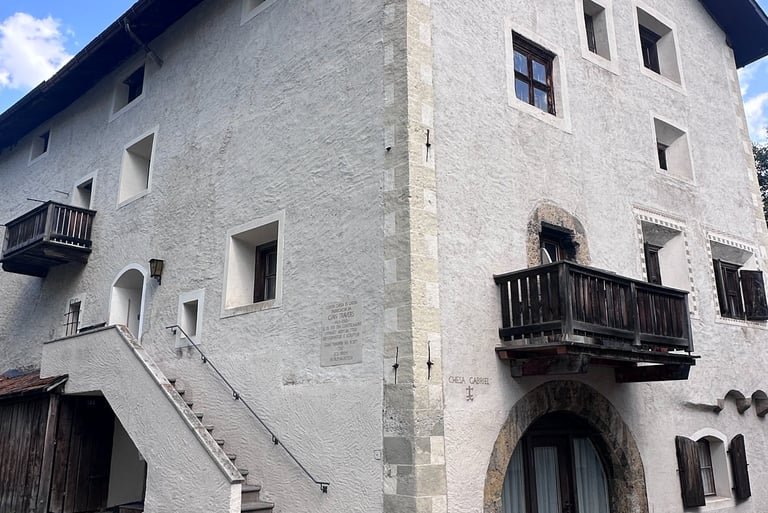
Romansh is a language spoken mainly in the canton of Grisons. It has been one of Switzerland’s national languages since 1938. Although it represents only about 0.5% of the Swiss population at the beginning of the 21st century, it keeps a strong cultural value, with newspapers and magazines published in Romansh. Its origins go back to the Romanization of these Alpine areas, conquered by the Romans in 15 BC, when the local populations gradually absorbed Latin.
During the Middle Ages, the area where Romansh was spoken extended far beyond the regions where it survives today. From the 8th–9th centuries, the growing Germanic influence gradually reduced the prestige of the language. Romansh remained a spoken language but never developed a unified written standard, while German became the official language. In the 19th century, spoken use declined further, but at the same time a movement to protect the language was born, with associations such as the Societad Retorumantscha (1885) and the Lia Rumantscha (1919). Today, Romansh is divided into five main dialect groups: Sursilvan, Sutsilvan, Surmiran, Ladin Puter, and Ladin Vallader. The last two are spoken in the Upper Engadine and Bergün (Puter), and in the Lower Engadine and Val Müstair (Vallader). Romansh speakers refer to them together as rumantsch ladin.
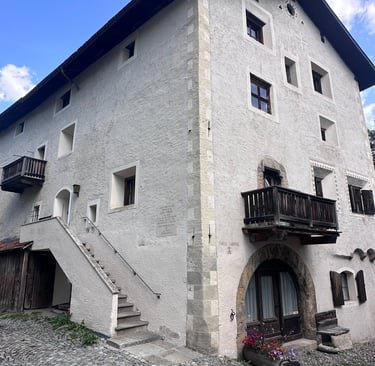
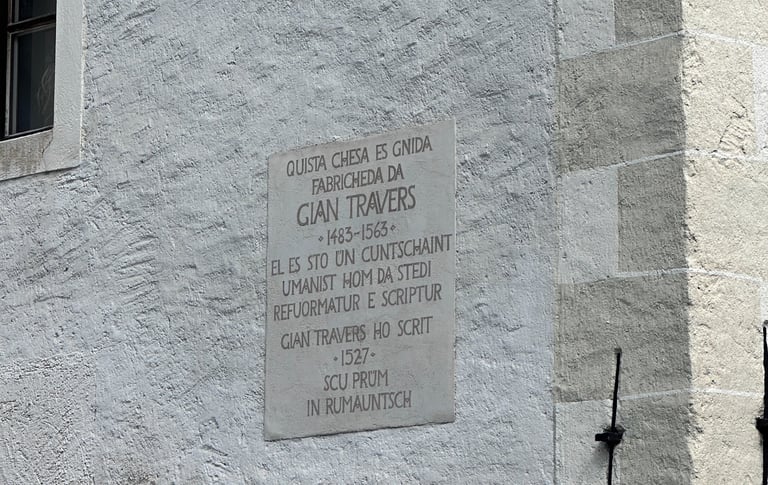
One of the leading figures of Romansh literature in the Upper Engadine was Gian Travers (1483–1563). Born and died in Zuoz, he studied humanism and law at German and Transylvanian universities. Travers was an important jurist, political and military leader, serving thirteen times as Landammann (chief magistrate) of the Upper Engadine and playing a key role in strengthening the Free State of the Three Leagues, for example by contributing to the drafting of the Ilanz Articles in 1524.
Travers is especially famous for his literary works, which helped establish the written language of the Upper Engadine and Romansh. His Chanzun da la guerra dalg Chiastè d'Müs (Song of the War of Musso Castle), composed in 1527, is a rhymed chronicle of 700 verses describing his imprisonment during the war at Musso Castle. This work is considered the oldest document of Romansh literature, making him a pioneer and co-founder of the written language of the Upper Engadine.
From 1534 onwards, Travers was also the first to have his biblical dramas performed in Romansh. These plays had a deep impact on the people of the Engadine. One such work, La histoargia da Joseph (The Story of Joseph), is considered the first Romansh play, performed in Zuoz in 1534. Several manuscripts of Joseph survive, including one from 1567, only four years after Travers’s death, which is probably very close to the original.
Travers’s literary production, together with the Reformation and Counter-Reformation, started an important local literary tradition in the Engadine, and later also in Sutselva and Surselva. His efforts helped consolidate Romansh as a language capable of expressing complex religious and literary narratives, laying crucial foundations for its future development.
Beyond his literary work, Travers was deeply interested in religious issues and influenced by the Devotio moderna movement. He promoted religious tolerance at the Disputation of Susch in 1537. Although he initially hoped for reconciliation between Catholics and Protestants, he converted to the Reformed faith in 1552 after the interruption of the Council of Trent, marking the beginning of the second phase of the Reformation in the Grisons.
Related Stories
Address
ENGADINWALKS.COM - GUIDED WALKS
Chesa Müstaila - Zuoz
Contacts
COSTANZA SAN MAURO
info@engadinwalks.com